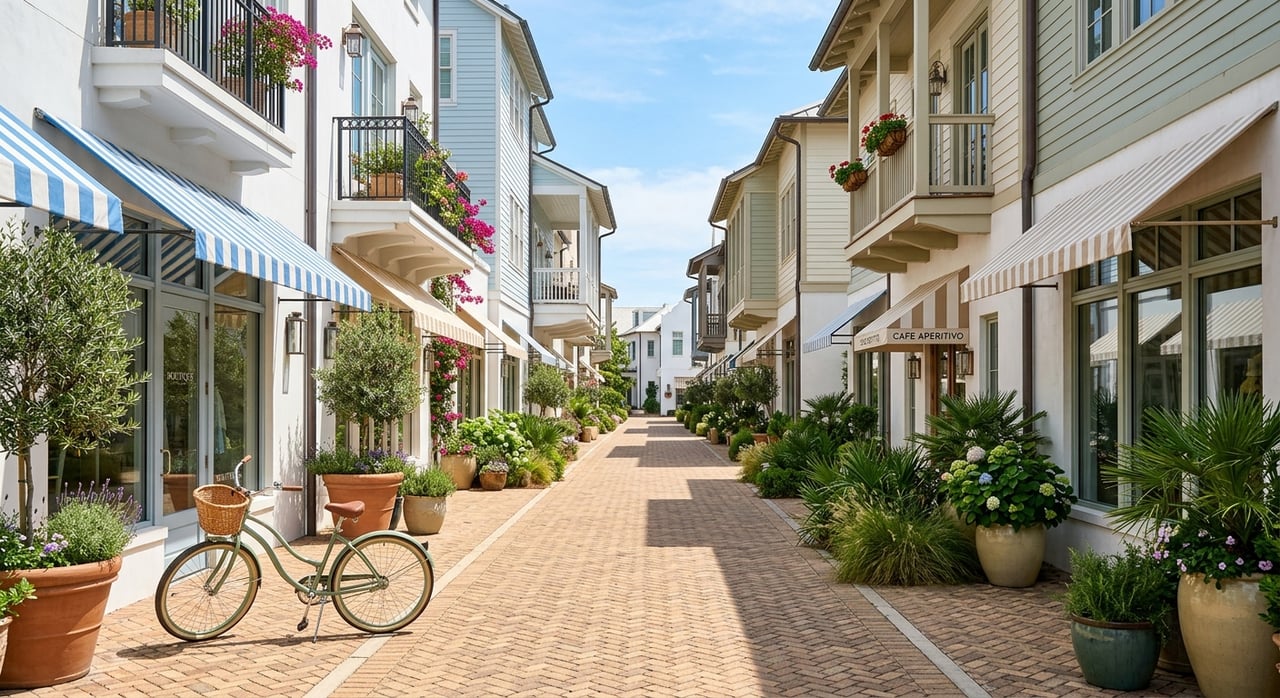
Wondering whether Seaside really lives up to its walkable reputation? If you are comparing 30A communities, that question matters because daily convenience, beach access, and how a home connects to town can shape your experience as much as the property itself. The good news is that Seaside was intentionally planned for life on foot, and understanding how its town center works can help you narrow your search with more confidence. Let’s dive in.
What Makes Seaside Walkable
Seaside was designed as a compact, mixed-use, pedestrian-first town in Walton County along Scenic Highway 30A. Official town history and Seaside Institute materials describe it as a New Urbanist community where cottages, shops, dining, and the beach are connected by narrow brick-paved streets and white-sand footpaths.
That design is not just a branding idea. The Seaside Institute says the town is about a 10-minute walk from end to end, with homes generally about a five-minute walk from the town center. In practical terms, that means many everyday stops can feel close together instead of spread across a car-dependent layout.
For buyers, that compact design can change how you evaluate a property. Instead of asking only how many bedrooms or parking spaces a home has, it also makes sense to ask how the home fits into Seaside’s footpath network, beach access points, and town-center flow.
Why Central Square Matters
Central Square is the heart of Seaside’s daily rhythm. Seaside’s history notes that the square was central to the original design, with shopping and dining placed within a five-minute walk of residences and The Court.
That matters because the town center is more than a place to browse a few shops. It acts as Seaside’s civic, retail, dining, and event core, giving the community a clear everyday anchor instead of pushing activity into scattered commercial areas.
You can see that in the businesses and public spaces gathered there. The shopping guide places independent retailers like Sundog Books, The SEASIDE Style, Mercantile, Town Square Shoes, Brothers, and Central Square Records in the area, while nearby dining includes Great Southern Cafe and 87 Central Square.
Town Center Is Also Community Space
Walkability in Seaside is not only about errands. It is also about how public spaces support a day that unfolds naturally on foot.
The Seaside Amphitheater and Lyceum Lawn help make that possible. Seaside’s green-space information describes these areas as shared spaces for concerts, movies under the stars, theater performances, school physical education, and weekend town events.
That combination of retail, dining, and gathering space is a big reason Seaside feels like a true town center. You are not just walking to a store or restaurant. You are walking into a setting that supports a fuller day-to-day lifestyle.
How Dining Fits the Walkable Layout
Seaside’s food options are spread through small, connected clusters rather than one large strip built around parking lots. That layout supports the town’s pedestrian design and gives you multiple ways to move through the community depending on where you start.
According to Seaside’s dining guide, options are found around Central Square, Airstream Row, the Coleman Pavilion area, and beach-edge spots close to the Gulf. For a buyer or second-home owner, that means your routine can vary by location while still staying walkable.
If you live closer to the center, grabbing coffee, lunch, or dinner may feel especially easy without moving your car. If you are positioned nearer the Gulf, you may still be a short walk from food options, but your path and daily pattern may look a little different.
Beach Access Is Built Into the Town
A big reason Seaside’s walkability stands out is that the beach is part of the town’s structure, not separate from it. Seaside has nine iconic beach pavilions, each marking a distinct beach access point.
Coleman Pavilion serves as the central beach access point. The Seaside Pavilion sits at the Gulf-front end of Seaside Avenue and acts as a community hub for activities like morning yoga and sunset gathering. Other pavilions, including West Ruskin, East Ruskin, Pensacola, and Natchez, serve specific street-based residential areas.
Seaside’s FAQ says beach access points are distributed throughout town, and most guests can reach the Gulf within a short walk. That is a major lifestyle advantage if your goal is to enjoy the beach as part of your regular routine instead of planning your day around driving and parking.
Why Exact Street Location Matters
Not every Seaside address functions the same way. The town’s FAQ notes that in the vacation-rental context, beach access is tied to the street where the home or cottage sits, and each street is managed by its own HOA.
That street-by-street structure means location within Seaside matters at a very local level. Two homes may both have a Seaside address, yet their relationship to a pavilion, pool, or the center of town can be meaningfully different.
This is where local guidance becomes valuable. If you are buying in Seaside, it helps to look beyond the map pin and understand how a specific street connects to the beach, public spaces, and daily walking patterns.
How Housing Pockets Connect Differently
Seaside works best when you think of it as a series of connected pockets rather than one uniform grid. Each pocket has its own relationship to the town center, the Gulf, and public amenities.
Homes near Central Square or Quincy Circle tend to be the most center-oriented because they sit closest to Seaside’s commercial and civic core. If you want the easiest walk to shops, dining, and events, those areas may feel especially convenient.
The Court is another helpful landmark in understanding the layout. Seaside describes it as centrally located and just steps from the beach, downtown Seaside, Coleman Pavilion access, and the amphitheater, which shows how closely some parts of town tie multiple amenities together.
Beachfront and street-based pockets operate a bit differently. Seaside Avenue connects directly to the Seaside Pavilion and Gulf-front edge, while streets like West Ruskin, East Ruskin, Pensacola, and Natchez connect through their own pavilion and access patterns.
Ruskin Place Offers a Different Feel
If you are drawn to a more arts-oriented pocket within the walkable core, Ruskin Place stands out. Seaside’s art coverage places much of the town’s creative identity there and on the sidewalks of Central Square.
Merchant information also shows boutiques and gift shops in that area. For some buyers, that can translate into a setting that feels a little more tucked in while still staying connected to the center of town.
That is one of Seaside’s strengths. Walkability does not mean every part of town feels identical. It means different pockets connect to the same larger system in different ways.
What Daily Life Can Look Like
One of the easiest ways to understand Seaside is to picture how a normal day might unfold. Because the town is compact, your routine can often feel simple and fluid.
If you own near the center, you might walk to coffee, browse Central Square, head to the beach through your street’s assigned pavilion, and then return for an evening event at the amphitheater. If you live closer to the Gulf, your day may start with a beach walk, move to lunch near Airstream Row or Central Square, and end around Seaside Pavilion or Coleman Pavilion at sunset.
These are not fixed schedules, of course. They are just useful examples of how Seaside’s existing layout supports a car-light lifestyle that many buyers are specifically looking for on 30A.
Amenities That Support Car-Light Living
Seaside’s activity programming also reinforces the town’s pedestrian design. The Athletic Club lists options such as a walking club, tennis clinics, water aerobics, and beach volleyball at Coleman Pavilion.
The Adult Pool is located at the north end of Seaside Avenue, and the Family Pool is at the northeast corner of Seaside. Again, the key takeaway is that amenities are woven into the town rather than separated into distant zones.
For buyers, that can make a real difference in how a property lives day to day. A home’s value is not only about the interior. It is also about how naturally the surrounding town supports the lifestyle you want.
What Buyers Should Focus On
If Seaside is on your shortlist, it helps to evaluate homes with the town’s planning logic in mind. The right property for you may depend less on being in Seaside generally and more on being in the right pocket of Seaside.
Here are a few smart things to compare:
- Distance to Central Square
- Street-specific beach access and pavilion location
- Proximity to gathering spaces like the amphitheater
- Access patterns to pools and activity areas
- Whether you want a center-oriented, Gulf-edge, or arts-oriented setting
This kind of property search benefits from local, street-level insight. In a town where so much is organized on a fine-grained pedestrian scale, small location differences can have an outsized impact on your ownership experience.
If you are weighing Seaside against other 30A communities, the biggest takeaway is simple: Seaside was intentionally built to make walking part of everyday life. Its compact layout, Central Square core, distributed beach pavilions, and connected public spaces all work together to create a town-center lifestyle that feels distinct on the Emerald Coast.
Whether you are looking for a second home, a primary residence, or a property with strong lifestyle appeal, understanding Seaside’s block-by-block layout can help you buy with more clarity. If you want help comparing specific streets, access patterns, and property options in Seaside and along 30A, connect with the Justin Myers Real Estate Team.
FAQs
Is Seaside, Florida actually walkable for daily life?
- Yes. Official Seaside materials describe it as a pedestrian-first town, and the Seaside Institute says the community is about a 10-minute walk end to end.
Why is Central Square important in Seaside?
- Central Square functions as Seaside’s civic, shopping, dining, and event core, with many homes placed within about a five-minute walk of it.
How close is the beach from most homes in Seaside?
- Seaside’s FAQ says beach access points are spread throughout town, and most guests can reach the Gulf within a short walk.
Do different Seaside streets have different beach access patterns?
- Yes. Seaside’s FAQ says beach access is tied to the street where a home or cottage sits, and each street is managed by its own HOA.
Which areas of Seaside feel closest to town center living?
- Homes near Central Square, Quincy Circle, and landmarks like The Court tend to be the most closely connected to the town’s core amenities.
What makes Ruskin Place different within Seaside?
- Ruskin Place is closely tied to Seaside’s arts identity and offers an arts-oriented pocket within the broader walkable core.